
When I Learned Feeding Evaluations Belong in the IEP Conversation
For a long time, feeding wasn’t a normal part of our day. It wasn’t “try a new food” or “he’s picky.” It was constant management and constant fear.
My son couldn’t move food back into his mouth. It was almost like his tongue was in the way, blocking what his body didn’t know how to do. He lived on purees and liquids, and even those weren’t easy. He struggled to gain weight. Most of the time, food ended up down his chin unless I prompted him to open wider, and I physically depressed his tongue just to get the spoon in.
Once food was in his mouth, he didn’t wasn’t sure what to do with it. Liquids pooled. Purees sat. He gagged. He choked. And that kind of choking changes you. You start watching every swallow like it’s a countdown.
It was 2017 when he transitioned into Part B, his first IEP felt “okay” on paper. He was found eligible under autism because we didn’t have a formal diagnosis yet. He was placed in a classroom with many high-needs students like him, but it was supposed to be 50% general education. But the day-to-day reality didn’t match the paper. Eating at school was still a struggle, and snack time wasn’t just a routine. It was a barrier. It was a safety issue. It was exclusion in plain sight. He would come home very hungry as if he had not eaten all day, which I found out was the case.
I brought my concerns to his OT and his speech therapist. I raised it at an IEP meeting. One teacher even acknowledged that feeding was a need. But the director prevented it from being added to the IEP. Another staff member suggested that new supplementary aids could be implemented and that OT could assist. That was denied, too.
Then I was told something I will never forget: “We don’t do feeding therapy. If you want that, you’ll need to have an outside provider and pick him up at before he needs to eat.”
I didn’t have the legal language back then. I didn’t know what FAPE meant yet. I couldn’t quote regulations. But I knew something wasn’t humanly right about my child being unable to eat at school like other children. He couldn’t access snack time. He couldn’t participate safely. I was being told that was simply not the school’s problem.
The moment instinct turned into research. He had a private therapist, who became a close friend. She looked at me and said what my gut had been screaming: this isn’t right. Feeding support can fall under an IEP when it meets criteria and impacts access. Hearing that made me even angrier, because it meant this wasn’t just a denial, it was deception. I was being told something was impossible when it wasn’t. I was being pushed away when I was asking for help.
I can’t even tell you who referred me to UPLIFT, but when I met with them, I walked in expecting another fight. I thought I was going to have to justify his needs all over again. It was the opposite.
They met me with understanding. They met me where I was. They didn’t make me perform my pain. We went through my son’s IEP together, and they helped me identify what was procedurally wrong, things I didn’t even know how to name at the time. They promised to attend the meeting with me.
That meeting was different. I was equipped, and I was heard.
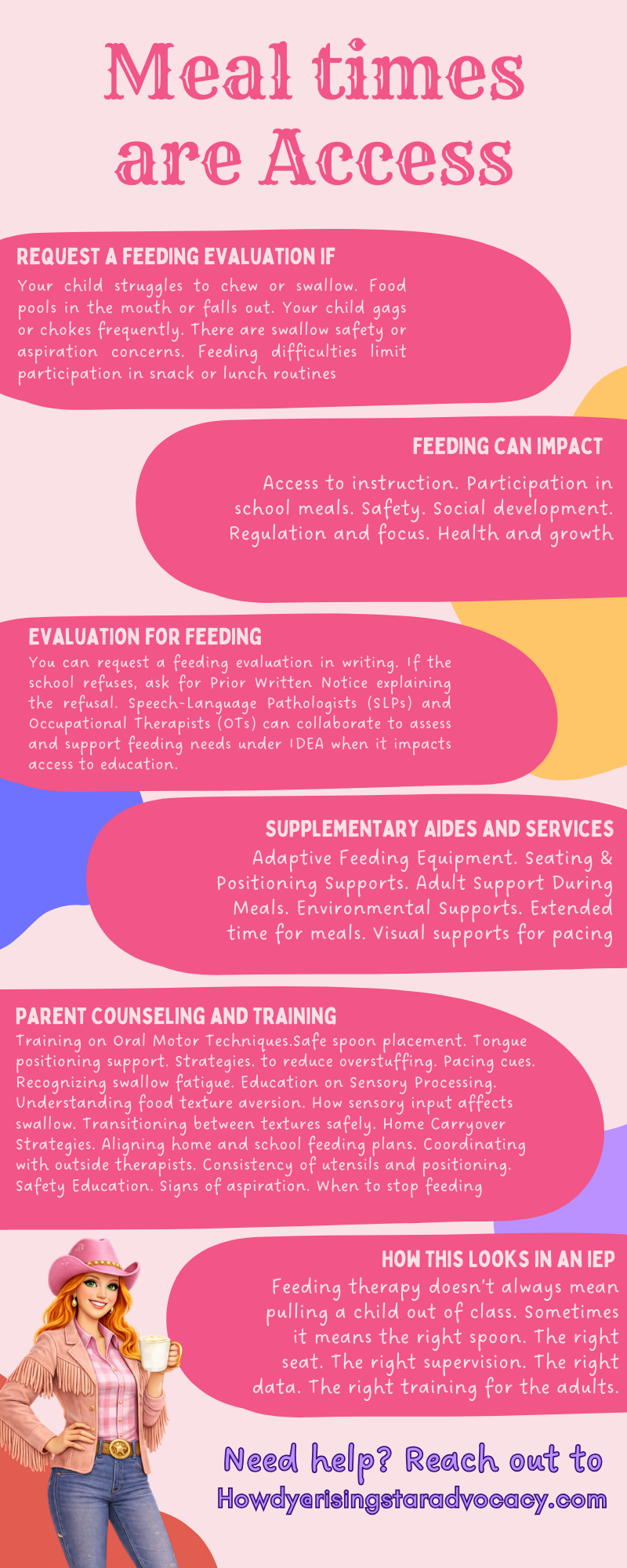
My son received new spoons. OT and speech evaluations were put into motion to dig deeper into what he actually needed. And yes, a feeding evaluation was completed, because feeding evaluations are within the purview of IDEA evaluations when they impact a child’s access and participation in the school day. Speech-language pathologists can complete feeding evaluations. Occupational therapy may also be involved depending on the areas of need.
When the feeding evaluation was finally done, it confirmed what I had lived: he wasn’t understanding the input of food in his mouth. He wasn’t aware it was there. He still struggles with this today and will overstuff his mouth. The evaluation reflected a combination of oral motor dysfunction, sensory processing differences, low tone, coordination needs, and swallow safety concerns. Yes, aspiration risk was real. He did choke then, and he still does at times.
That evaluation didn’t make me feel better, but it made me feel validated. It confirmed that “no” was never an appropriate answer. It also taught me something I’ve never forgotten: no degree can replace collaboration. You can have every credential in the world, but common decency and willingness to work with a parent has to come from the heart.
When we addressed the need, my son began to try solids. He still has challenges, but I cannot imagine where he would be if I had accepted “we don’t do that” as the final word.
If you’re reading this and your child can’t eat safely at school
You can ask the IEP team for a feeding evaluation when feeding impacts access, participation, or safety during the school day.
Put it in writing.
If someone tells you, “We don’t do feeding therapy,” ask them to document that refusal in Prior Written Notice and explain the basis for the decision. Ask what evaluations they relied on. Ask what options were considered and rejected.
Most of all, trust the part of you that knows when something isn’t right. You don’t have to know the statute first to know your child deserves access.
Sometimes advocacy starts with one simple truth: my child deserves to eat.

If you need help, please reach out!


Leave a Reply